This is a guest piece by Chris, a friend of The Quiet Vacationer and a United Airlines Million Miler.
The Quiet Vacationer messaged me shortly after landing in Singapore.
He had been on UA1, United Airlines’ non-stop flight from San Francisco to Singapore. About 30 minutes after taking off, the captain came over the public address system.
This was not the usual mid-flight update about their position over the Pacific or the weather ahead. Someone on board had just crossed one million lifetime flight miles with United Airlines, and the captain wanted the cabin to know.
The Quiet Vacationer never found out who the passenger was. But he knew I had crossed the same milestone myself several years earlier. In fact, we had met in New York during the trip on which I eventually became a Million Miler.
A captain can announce the number in a few seconds. Getting there takes rather longer. For me, it took almost three decades.
What counts towards United Airlines Million Miler status
United Airlines calculates Million Miler status using the actual distance flown on eligible paid United Airlines and United Express flights.
Frequent flyers often call these “butt-in-seat” miles, which is a fairly accurate description. You have to be sitting on an eligible revenue flight while the aircraft covers the distance. Miles earned from credit cards do not count. Neither do award tickets, partner flights or cabin bonuses.
Flying 8,000 miles in Economy counts for the same lifetime distance as flying 8,000 miles in Polaris. The fare may be very different, but the aircraft covers the same number of miles.
This makes Million Miler status quite different from ordinary annual elite status. These days, most airline status programmes place considerable weight on spending. United Airlines’ lifetime programme is still based on distance.
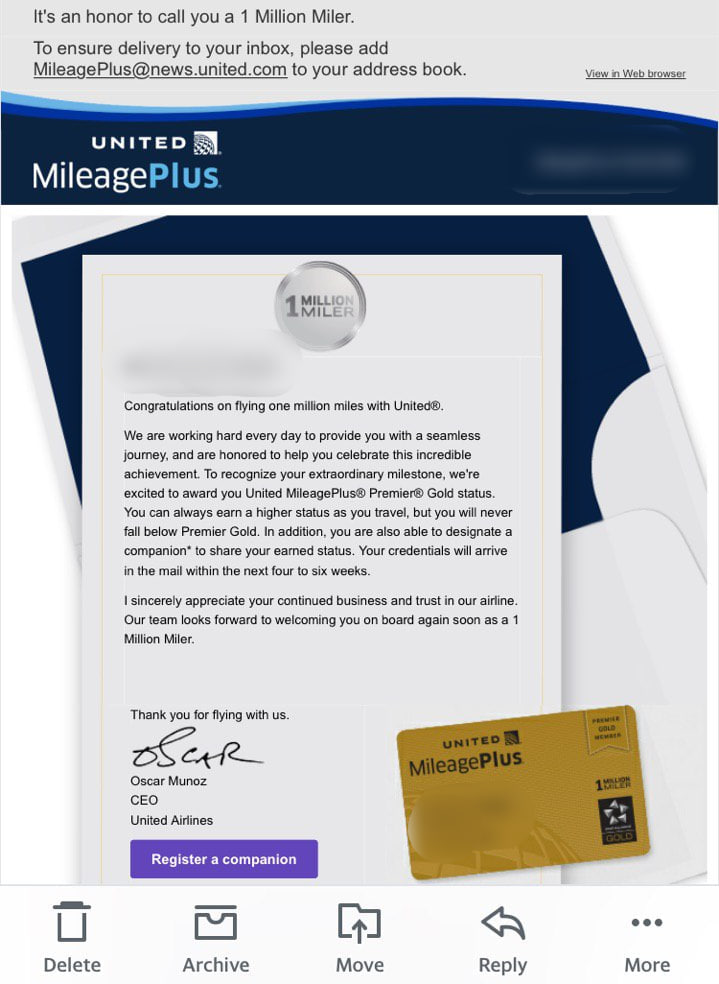
At one million qualifying miles, a member receives lifetime Premier Gold. Two million miles brings lifetime Premier Platinum, while three million brings lifetime Premier 1K. Four million miles earns lifetime Global Services, a tier that United Airlines otherwise awards by invitation rather than through published annual qualification requirements.
The status does not need to be renewed. Once you have crossed the relevant mileage threshold, the corresponding tier is yours for life.
There is also a companion benefit. A Million Miler can nominate a spouse, partner or another person living at the same address to receive status.
Through the end of 2026, that companion’s tier matches the Million Miler’s current Premier status, even when the member has qualified above their lifetime tier for the year. From 2027, companions of 1 Million Milers will receive Premier Gold regardless of the primary member’s higher annual status. The existing arrangement remains for those who have reached two million miles or more.
For readers in Singapore, perhaps the easiest comparison is Singapore Airlines’ PPS Club. PPS status has to be renewed through qualifying premium-cabin spending. United Airlines Million Miler status is earned through a vast amount of eligible flying, but once it has been awarded, there is no annual renewal requirement.
I have not come close to flying one million miles again since 2019. I remain a lifetime Premier Gold member.
It took me almost three decades
I started flying with United Airlines in July 1990.
When I crossed one million miles in December 2019, I had been flying with the airline for nearly 30 years. The captain on The Quiet Vacationer’s recent flight said that the average Million Miler takes about 14 years to reach the mark. I took more than twice as long.
There was never a 30-year plan. I did not take my first United Airlines flight in 1990 and decide that I would eventually fly one million miles with the airline. I doubt many people do. At that point, one million miles would have sounded more theoretical than achievable. The total accumulated gradually. One flight became another. Work trips, personal trips, long-haul sectors and domestic connections all added to the same balance.
For years, the number was simply there in my MileagePlus account. Then it became large enough to notice. Eventually, one million miles stopped looking completely impossible. Even then, I did not arrange a ceremonial final flight or choose a particular route so that I could cross the line somewhere significant. My normal travel happened to take me there.
After almost three decades, the final qualifying flight was UA28 from Singapore to San Francisco in December 2019.
Crossing one million miles on UA28
The flight itself began like any other long journey across the Pacific.
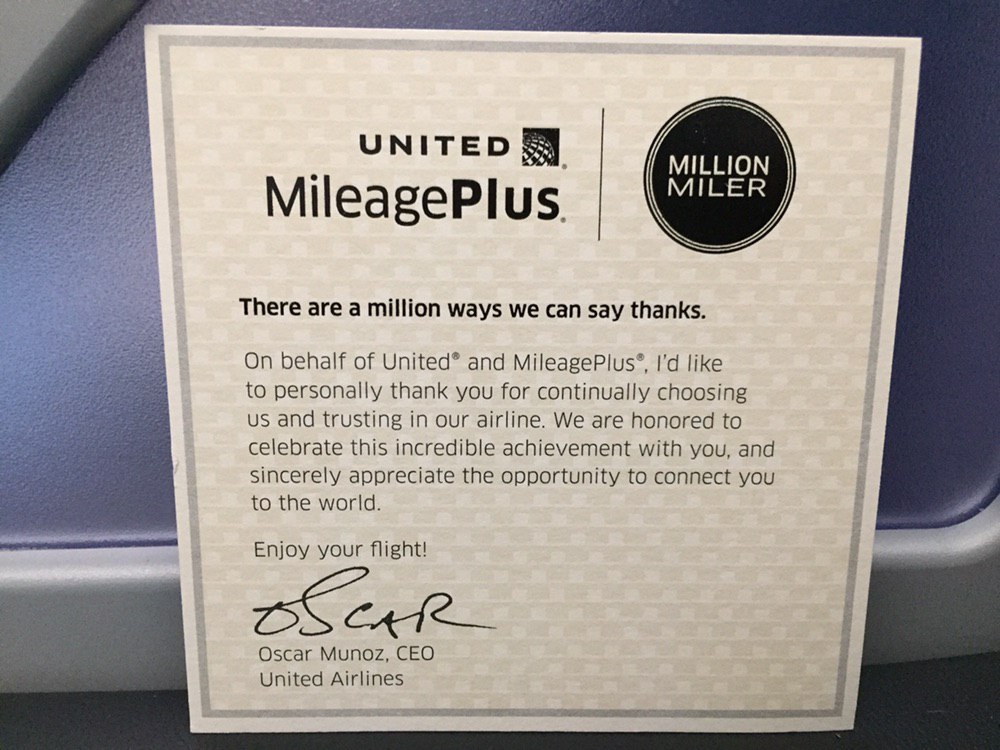
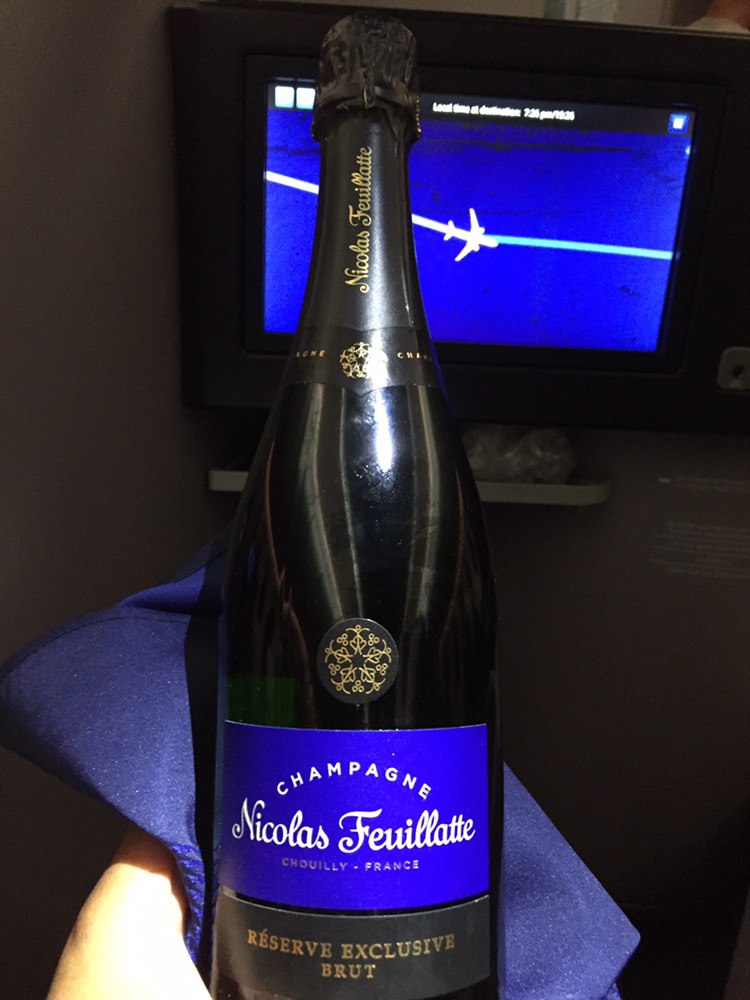
At some point during the flight, the crew worked out that I had crossed one million qualifying miles. I do not know whether the system alerted them automatically or whether someone had spotted it before departure, but a crew member came over with a bottle of champagne and quietly congratulated me.
There was no announcement to the rest of the cabin. No ceremony. I received a bottle of champagne, a card and a few kind words from the crew.
After so many years of flying, the understated recognition felt more appropriate than a cabin-wide celebration would have. The crew knew what the number meant, and they took the time to acknowledge it without making a production out of the occasion.
In hindsight, the timing was extraordinarily fortunate. I crossed the threshold in December 2019, only a few months before the COVID-19 pandemic brought international aviation to a halt. Had my travel pattern been slightly different, I might have ended 2019 just short of one million miles.
At the time, nobody on that flight knew what was coming. We had all boarded another routine transpacific service, expecting the usual sequence of arrivals, departures and future trips to continue. A few months later, those routines disappeared. Had I needed another few long-haul flights to reach the milestone, I could easily have been waiting until 2021 or later.
The next flight: a card and a voucher
The more memorable recognition came on my return journey to Singapore.
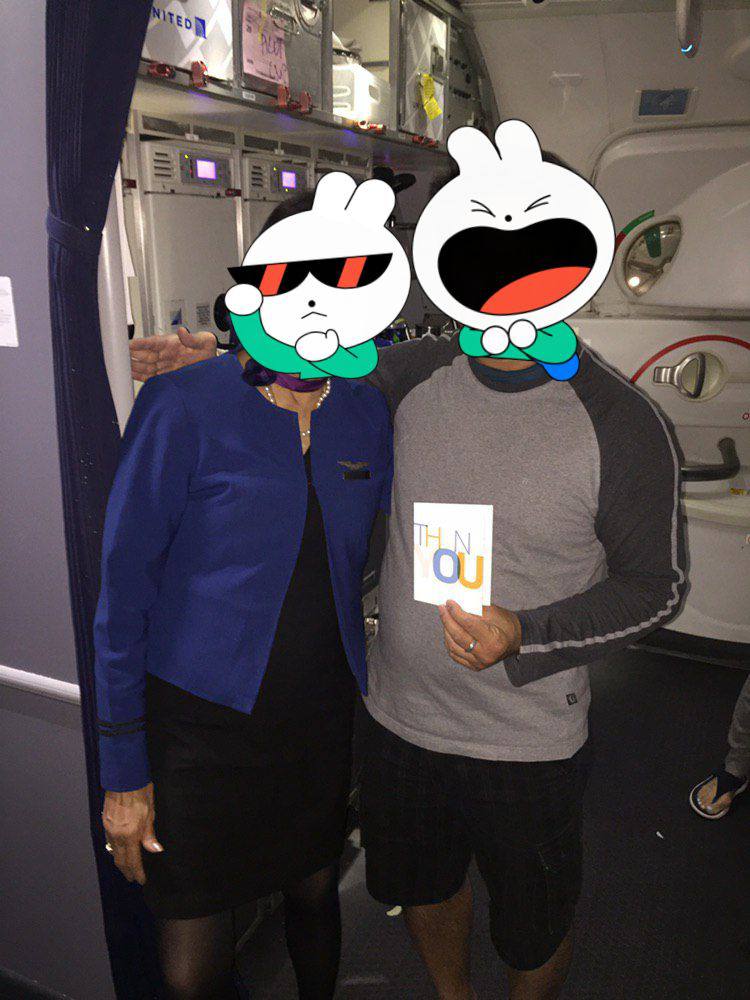
I was travelling on UA1 from San Francisco. During the flight, the purser stopped at my seat and presented me with another handwritten card. This time, United Airlines also gave me a US$200 travel voucher to mark the achievement.
Lifetime Gold, but Premier 1K that year
Crossing one million miles gave me lifetime Premier Gold, but I was already flying enough at the time to earn a higher tier through the normal annual qualification process.
Around the same period, I qualified for Premier 1K on my own flying activity. My annual status was therefore Premier 1K, while Premier Gold became the lifetime floor below which I would no longer fall.
This distinction is important. Million Miler status does not necessarily replace the status someone earns each year. It guarantees a minimum tier.
A 1 Million Miler who earns Premier 1K in a particular year will still receive Premier 1K benefits for that membership period. If the member later reduces their flying and no longer qualifies annually, they return to their lifetime Premier Gold status rather than dropping to general membership.
That is more or less what happened to me. I was flying heavily enough in 2019 to reach Premier 1K. The years since then have looked very different, but the Premier Gold status remains.
The plaque arrived just before the world stopped
United Airlines also sends Million Milers a physical recognition pack. Mine took some time to arrive. Although I had crossed the threshold in December 2019, the package only reached me in February 2020.
The plaque reflected the status I held at the time. Since I had achieved one million miles while holding Premier Platinum status, it was printed with a Platinum card rather than the Gold tier that I had earned for life.
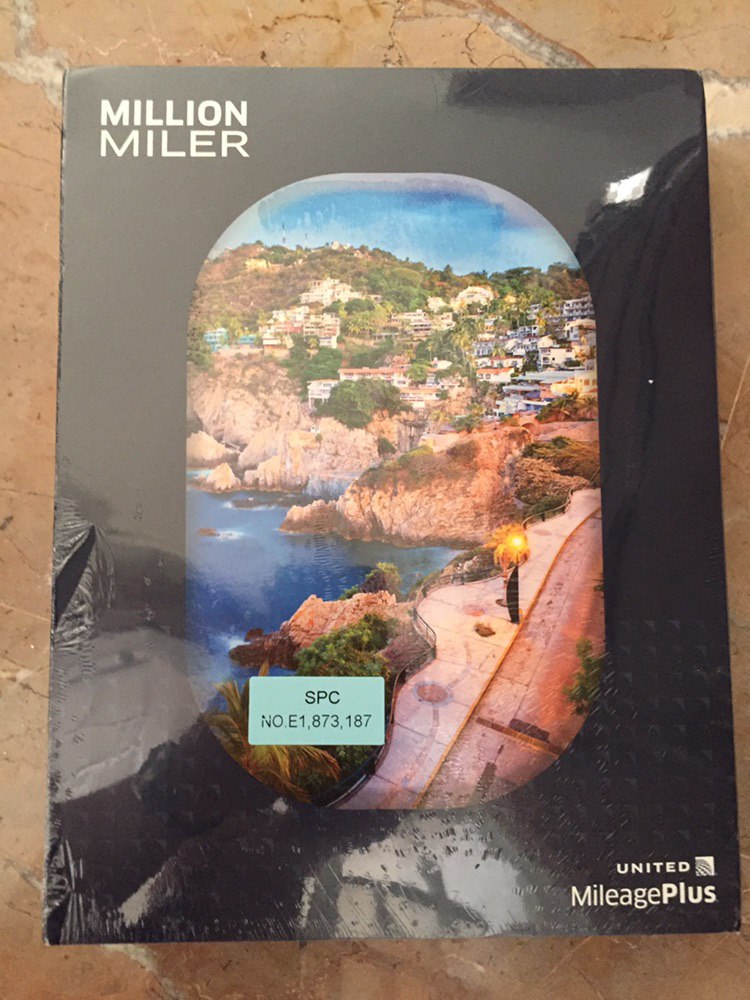
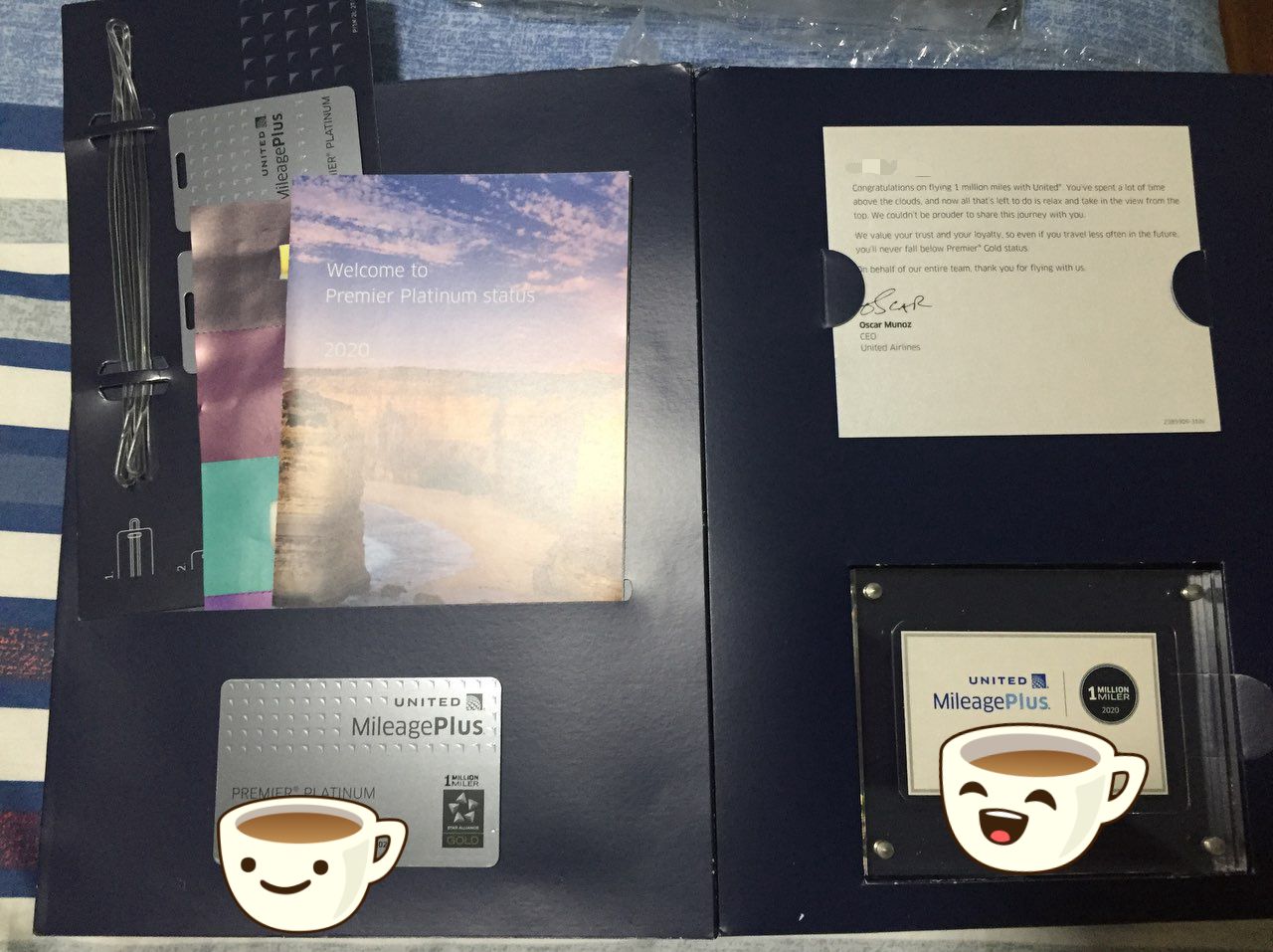
By the time it arrived, reports about a new virus were becoming increasingly difficult to ignore. Soon afterwards, borders closed and the aviation world I had spent nearly 30 years travelling through came to an abrupt stop.
The plaque therefore arrived at a peculiar moment. It recognised decades of almost continuous flying just as flying itself was about to become impossible for most of the world.
I did not know that when I opened the package, of course. At the time, it was simply the final physical acknowledgement of a milestone I had already crossed several weeks earlier.
What one million miles means to me
People understandably focus on the benefits when discussing lifetime airline status.
Premier Gold brings Star Alliance Gold, Economy Plus access, additional baggage and the other benefits attached to the tier. The companion status can be even more valuable, particularly when two people regularly travel together.
Those benefits matter. I would not pretend otherwise.
But they are not what I first think about when someone mentions my Million Miler status.
The number represents nearly three decades of my life. It includes places I needed to be, places I wanted to see, people I travelled with and an enormous number of hours spent inside United Airlines aircraft.
Much of it was entirely ordinary. Most of the individual flights have long since blended together. I could not list every route, aircraft or seat even if I tried.
That is the curious thing about reaching one million miles. The total sounds dramatic. The process rarely is.
You get there one flight at a time.
Back to the passenger on UA1
The Quiet Vacationer still does not know who crossed one million miles on his recent UA1 flight.
Perhaps the passenger had been tracking the balance for months and knew exactly which sector would take them over the line. Perhaps the announcement came as a surprise. They may have reached it in 10 years, 20 years or, like me, after the better part of three decades.
I hope the announcement meant something to them. One million flown miles is not a small achievement. It requires years of returning to the same airline, often when another carrier might have been cheaper, faster or more convenient. Even for a frequent business traveller, it takes an extraordinary amount of time in the air.
United Airlines could allow the threshold to pass as quietly as any other number changing in a MileagePlus account. In my case, it did not. Two crews, on two different flights, took the time to recognise what had happened. One brought champagne. Another brought a card and a travel voucher. None of it was extravagant, but it did not need to be.
After almost 30 years and one million miles, being remembered was enough.